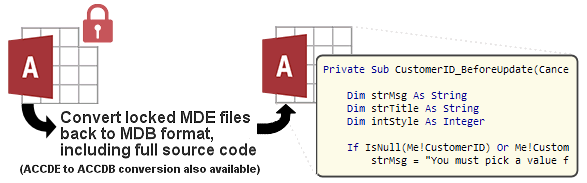
IN THE SPOTLIGHT: MDE to MDB Conversion Service
(also supports: ACCDE to ACCDB, ADE to ADP, etc)
IN THE SPOTLIGHT: Access Database Repair Service
An in-depth repair service for corrupt Microsoft Access files

IN THE SPOTLIGHT: vbWatchdog
VBA error handling just got easier...

" vbWatchdog is off the chart. It solves a long standing problem of how to consolidate error handling into one global location and avoid repetitious code within applications. "
- Joe Anderson,
Microsoft Access MVP
Meet Shady, the vbWatchdog mascot watching over your VBA code →
(courtesy of Crystal Long, Microsoft Access MVP)
IN THE SPOTLIGHT: vbMAPI
An Outlook / MAPI code library for VBA, .NET and C# projects
Get emails out to your customers reliably, and without hassle, every single time.

Use vbMAPI alongside Microsoft Outlook to add professional emailing capabilities to your projects.
IN THE SPOTLIGHT: Code Protector
Standard compilation to MDE/ACCDE format is flawed and reversible.
Lissa Aires checked the time on her phone: 11:43 p.m. Night shift at St. Maren’s meant the hospital breathed differently after dark—quieter, but sharper. The fluorescent lights hummed above the nurses’ station as Lissa capped her pen and pulled her cardigan tighter. Tonight she was the only registered nurse on the medical-surgical floor; the usual team was stretched thin after a busier-than-expected evening.
By noon she’d be back—lunch, errands, and the small domestic life she stitched into the space between shifts—but for now the night belonged to the patients she’d kept steady. Lissa drove home under a pale sky, tired but whole, already thinking of the next shift and ready to be there again when someone needed her calm steady hands. lissa aires nurse exclusive
At 1:12 a.m., the emergency bell rang. Lissa sprinted, heart steady, training igniting. The trauma bay held a young woman with a shattered femur and a worried boyfriend who kept asking if she’d be okay. Lissa relayed information to the ER team, set up IV access, and administered pain control per protocol. Her hands were efficient but gentle; she explained each step to the patient and placed a cool compress on her forehead. The attending physician later praised her clarity and speed—small acknowledgments that made the long hours worth it. Lissa Aires checked the time on her phone: 11:43 p
Around 3:30 a.m., Lissa paused at the window outside the nurse’s station. Rain threaded the streetlamps like beads. She allowed herself the briefest breath, thinking of her mother, who’d once told her that caring for others meant remembering to care for herself. Lissa had learned to steal small moments—an apple between rounds, a five-minute stretch in supply closet doorway—little anchors through the long nights. The fluorescent lights hummed above the nurses’ station
A tech called for help transferring an elderly woman with dementia who had become agitated. Lissa sank into the rhythm: a soft voice, a familiar song hummed low, a hand to guide. The woman’s muscles relaxed. Later, she mouthed “Thank you,” and Lissa felt the warmth of human connection that made the exhaustion a trade worth making.
On the street outside, the city exhaled into morning. Lissa walked to her car, feet aching, uniform still slightly wrinkled. She thought of the voicemail from her sister about Sunday dinner, of a promise to pick up groceries, of a novel waiting on her nightstand. Nursing demanded resilience and quiet heroism, and Lissa carried both with humility. She unlocked her phone, sent a quick text—“I’m home safe”—and let herself feel the small, fierce pride that came from seeing people through the hardest hours.

