
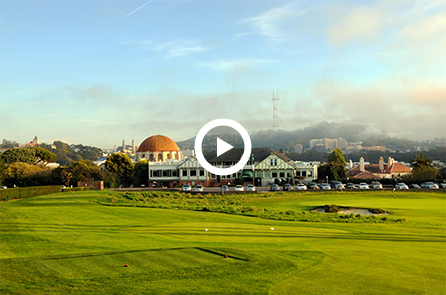
About Presidio Golf Course

Located within a national park, San Francisco’s Presidio Golf Course is renowned for its spectacular forest setting, as well as its challenging play. Once restricted to military officers and private club members, today the 18-hole course is open to the public. Presidio G.C. offers a full service restaurant, a driving range and practice facility, and an award winning golf shop that offers the latest in golf equipment and apparel. Presidio Golf Course is a contributing feature of the Presidio’s National Historic Landmark status. It is also notable for its environmentally sensitive management practices.

The Course

God shaped this land to be a golf course. I simply followed nature.
– John Lawson, designer of the first course

Presidio Golf Course is built on a variety of terrains. Holes are constructed over a base of adobe clay, rock, sand, or a combination of all three. The early Presidio Golf Course was short, but challenging. Players were often shocked by the level of difficulty and natural obstacles. Lawson Little, stamped by Golf Magazine as the greatest match player in the game’s history, said, “I have played the best courses here and abroad, but none more enjoyable than my home course of Presidio. I learned how to strike the ball from every conceivable lie. Presidio demands accuracy, but being a long hitter, I also had to learn how to hook or fade around trees. I had the reputation of being a strong heavy-weather golfer; well, Presidio has powerful wind, rain, fog, sudden gusts, and sometimes all four on any given round.”

Environmental Sensitivity

Presidio Golf Course has been recognized as a leader in environmentally sensitive golf course management, winning the 2001 “Environmental Leader in Golf Award”. Since 2000, the course has reduced overall pesticide use by approximately 50%, and currently uses approximately 75% less pesticide than private courses in San Francisco. The course also received certification from Audubon International as a partner in the Audubon Cooperative Sanctuary Program in 2003.

The course uses an innovative form of pest management and turf management called compost tea. “Compost tea” is a solution made by soaking compost in water to extract and increase the beneficial organisms present in the compost. It is then sprayed over the greens. The result is turf with longer root growth and less plant disease fungi.

Exploitedcollegegirls.24.08.01.sloane.xxx.1080p... Link

The internet has democratized content creation, enabling creators to produce niche content that caters to specific audiences. Platforms like Twitch (gaming), Crunchyroll (anime), and Shudder (horror) have emerged to serve these niche markets. The proliferation of streaming services has also led to a resurgence in interest in local and international content, with platforms like Netflix and Amazon Prime investing in productions from around the world.

The early 20th century marked the beginning of the entertainment industry as we know it today. Radio, which emerged in the 1920s, was the first medium to bring entertainment into people's homes. Families would gather around the radio set to listen to news, music, and serialized stories. The 1940s and 1950s saw the rise of television, which quickly became a staple in American households. TV shows like "I Love Lucy," "The Honeymooners," and "The Ed Sullivan Show" became iconic, entertaining audiences and shaping popular culture. ExploitedCollegeGirls.24.08.01.Sloane.XXX.1080p...

The traditional linear TV model, where viewers were forced to watch content at a specific time, has given way to non-linear models, where viewers can watch what they want, when they want. Streaming services have disrupted the traditional TV model, offering a more personalized and flexible viewing experience. This shift has forced traditional TV networks and studios to adapt, experimenting with new formats, such as streaming services and online-exclusive content. The early 20th century marked the beginning of

Social media has had a profound impact on the entertainment industry, changing the way content is created, marketed, and consumed. Platforms like Instagram, Twitter, and Facebook have become essential tools for celebrities, influencers, and content creators to connect with their audiences. Social media has also enabled the rise of influencer marketing, with brands partnering with popular influencers to promote their products or services. The 1940s and 1950s saw the rise of

The 1970s and 1980s saw the proliferation of cable television, which expanded the reach of entertainment content. Cable channels like HBO, Showtime, and MTV (launched in 1981) offered new platforms for creators to produce innovative content. MTV, in particular, revolutionized the music industry by broadcasting music videos 24/7, making it a go-to destination for music lovers. The 1990s saw the emergence of reality TV shows like "The Real World" and "Survivor," which became huge hits and paved the way for future reality TV programming.

The 21st century brought about a seismic shift in the entertainment industry with the rise of digital technology and streaming services. The launch of YouTube in 2005 marked the beginning of user-generated content, allowing anyone to create and share their own videos. The 2010s saw the emergence of streaming giants like Netflix, Hulu, and Amazon Prime, which transformed the way people consume entertainment. These platforms offered on-demand access to a vast library of content, including original series, movies, and documentaries.

Presidio Golf Course, A National Historic Landmark

A National Historic Landmark Since 1962

Originally designed by Robert Wood Johnstone, the golf course was expanded in 1910 by Johnstone in collaboration with Wiliam McEwan, and redesigned and lengthened in 1921 by the British firm of Fowler & Simpson.

LEARN MORE

The internet has democratized content creation, enabling creators to produce niche content that caters to specific audiences. Platforms like Twitch (gaming), Crunchyroll (anime), and Shudder (horror) have emerged to serve these niche markets. The proliferation of streaming services has also led to a resurgence in interest in local and international content, with platforms like Netflix and Amazon Prime investing in productions from around the world.

The early 20th century marked the beginning of the entertainment industry as we know it today. Radio, which emerged in the 1920s, was the first medium to bring entertainment into people's homes. Families would gather around the radio set to listen to news, music, and serialized stories. The 1940s and 1950s saw the rise of television, which quickly became a staple in American households. TV shows like "I Love Lucy," "The Honeymooners," and "The Ed Sullivan Show" became iconic, entertaining audiences and shaping popular culture.

The traditional linear TV model, where viewers were forced to watch content at a specific time, has given way to non-linear models, where viewers can watch what they want, when they want. Streaming services have disrupted the traditional TV model, offering a more personalized and flexible viewing experience. This shift has forced traditional TV networks and studios to adapt, experimenting with new formats, such as streaming services and online-exclusive content.

Social media has had a profound impact on the entertainment industry, changing the way content is created, marketed, and consumed. Platforms like Instagram, Twitter, and Facebook have become essential tools for celebrities, influencers, and content creators to connect with their audiences. Social media has also enabled the rise of influencer marketing, with brands partnering with popular influencers to promote their products or services.

The 1970s and 1980s saw the proliferation of cable television, which expanded the reach of entertainment content. Cable channels like HBO, Showtime, and MTV (launched in 1981) offered new platforms for creators to produce innovative content. MTV, in particular, revolutionized the music industry by broadcasting music videos 24/7, making it a go-to destination for music lovers. The 1990s saw the emergence of reality TV shows like "The Real World" and "Survivor," which became huge hits and paved the way for future reality TV programming.

The 21st century brought about a seismic shift in the entertainment industry with the rise of digital technology and streaming services. The launch of YouTube in 2005 marked the beginning of user-generated content, allowing anyone to create and share their own videos. The 2010s saw the emergence of streaming giants like Netflix, Hulu, and Amazon Prime, which transformed the way people consume entertainment. These platforms offered on-demand access to a vast library of content, including original series, movies, and documentaries.

ExploitedCollegeGirls.24.08.01.Sloane.XXX.1080p...
Processing...
Thank you! Your subscription has been confirmed. You'll hear from us soon.
EMAIL SPECIALS
Join our email specials list to get our Weekly Update newsletter and occasional other specials and event announcements!
ErrorHere